
Alternative Energy ETFs and Mutual Funds Among Top Gainers in Entire Fund Universe
by Harris Roen, Editor
Roen Financial Report
November 20, 2013
The Roen Financial Report closely covers the universe of 30 alternative energy Mutual Funds (MFs) and Exchange Traded Funds (ETFs). We use a proprietary ranking method to pick the best funds, looking at measures that include fees, risk, tax liability, and the financial health of individual holdings within each fund. Subscribers can read a detailed report on green funds, including rankings and technical breakdowns, in both Excel and PDF format.
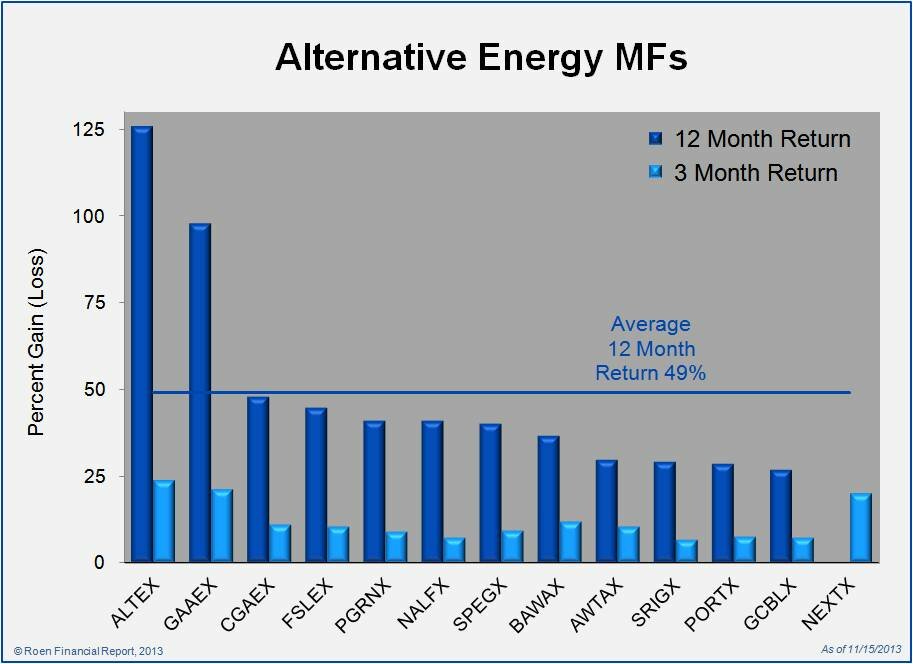
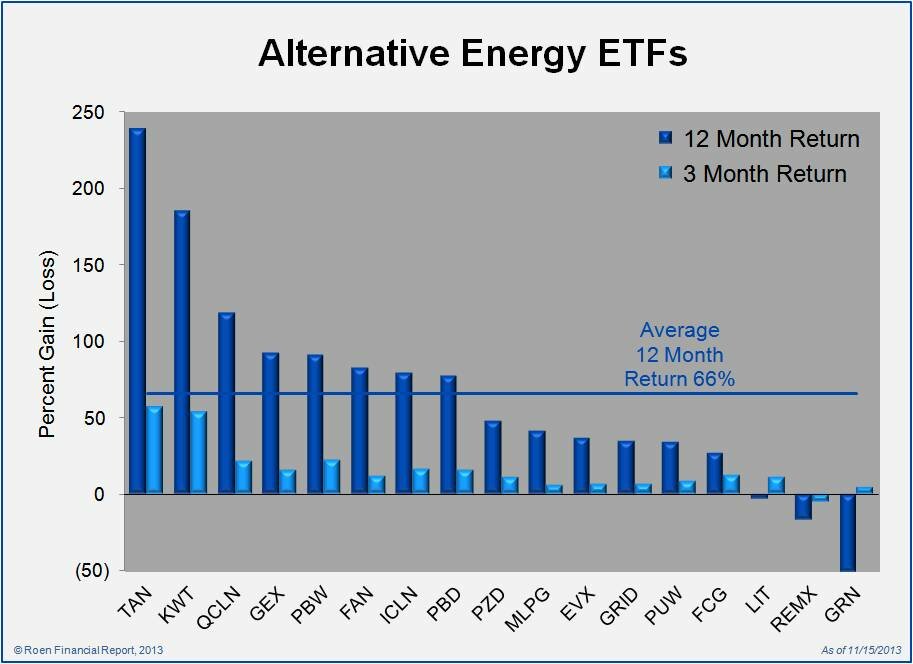
Alternative energy MFs and ETFs posted record gains in the past 12 months. Guggenheim Solar (TAN) and Market Vectors Solar Energy (KWT) are the top two performers out of more than 1,500 ETFs. Firsthand Alternative Energy (ALTEX) and Guinness Atkinson Alternative Energy (GAAEX) are in the top ten for over 28,000 mutual funds.
Mutual Funds
Returns overall have been spectacular for alternative energy MFs. Even the lowest performer is up 27% in the past 12 months. The best performers are those strongly invested in solar, specifically ALTEX and GAAEX, as the solar sector has been on an absolute tear. It should be noted, however, that some of these high fliers are still down from their highs of several years ago.
A new fund has been added to our ranking list, Green Century Balanced (GCBLX). It does not specifically invest in alternative energy companies, but instead has a broader green investment agenda. Its principal strategy is to invest in “environmentally responsible and sustainable U.S. companies, many of which also make positive environmental contributions.” There is a good Reuter’s article on GCBLX, recommending it for the fossil fuel divestment crowd. It comes onto the alternative energy mutual fund list as a Rank 2 (funds are ranked from 1 to 5, with 1 being the best).
Exchange Traded Funds
Returns for alternative energy ETFs have been strong, like their MF counterparts, though gains have been much more variable. TAN has returned an astounding 240% for the year, and Market Vectors Solar Energy (KWT) gained 185%.
Of the two funds, TAN is higher ranked due to several factors. TAN is a much larger ETF, managing over $400 million as compared to about $30 million invested by KWT. This makes TAN a more stable investment platform. Additionally, TAN has somewhat better fundamentals in its underlying assets when looking at price/sales and forward price/earnings ratios.
On the down side, three of the alternative energy ETFs show a loss for the year. iPath Global Carbon ETN (GRN) is down by more than half, reflecting the continued struggle in European carbon markets.
IMPORTANT INFORMATION
Individuals involved with the Roen Financial Report and Swiftwood Press LLC do not own or control shares of any companies mentioned in this article. It is also possible that individuals may own or control shares of one or more of the underlying securities contained in the Mutual Funds or Exchange Traded Funds mentioned in this article. Any advice and/or recommendations made in this article are of a general nature and are not to be considered specific investment advice. Individuals should seek advice from their investment professional before making any important financial decisions. See Terms of Use for more information.
Remember to always consult with your investment professional before making important financial decisions.
One Response to “Alternative Energy ETFs and Mutual Funds Among Top Gainers in Entire Fund Universe”
Leave a Reply
 |
As seen in USA Today Green Living! |

Subscribe to the Roen Financial Report and receive two free reports!
Get access to members-only areas of the website, including up-to-date stock reports in addition to alternative energy mutual fund & ETF rankings.


I am not an ETF basher and you did an excellent job on this article, but i did find an article that wen’t over the Risks of ETFs that you might want to check out here http://www.mutualfundstore.com